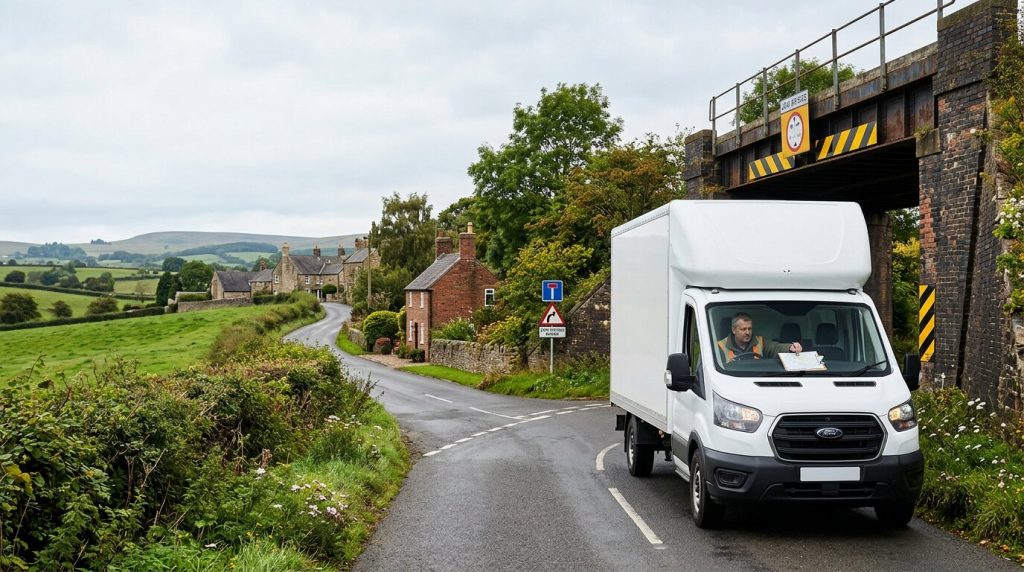
A satnav will happily send a hired Luton the same way it sends a hatchback. That’s the core problem with van journeys. The fastest route is worked out for cars, and the things that catch van drivers out, such as low bridges, car park barriers, narrow village streets and loading bays with canopies, don’t show up until you’re in front of them.
So plan in a different order. Find out exactly how big the van is, work out what has to happen at each end, and only then pick the roads. Do it that way round and the route usually sorts itself out.
Get the real dimensions before you plan anything
Hire listings tend to describe vans by type (short wheelbase, long wheelbase, Luton) rather than giving exact measurements, and the same label can cover different vehicles. Ask the hirer for three figures for the van you’ll actually be given: overall height, width including mirrors, and length. Write them on a piece of paper and stick it to the dashboard. Thinking about a low bridge isn’t the moment to try to remember them.
Height is the one that does the damage. A box-bodied Luton is a very different shape from a panel van. Hire-firm guides typically put a Luton at around three metres tall or more, which rules out height-restricted car parks almost entirely. Many multi-storey car parks are barriered at around two metres, so even a high-roof panel van may not get in. Don’t assume. Ask, and check the signed height at the entrance.
Network Rail’s guidance for professional drivers, published on GOV.UK as a bridge strike prevention guide, makes two points worth knowing even in a small van. Bridges are signed with a maximum height when the clearance is less than 16ft 3in (4.95m). At arch bridges the signed height only applies over a marked width, so the clearance near the kerb can be lower. If you do hit a bridge, phone the number on the bridge’s identification plate so the railway can be checked.
Plan the two ends first
Most van trouble happens in the last hundred metres, not on the M1. Before you think about the main route, find out:
- Where exactly you’ll stop to load and unload, and whether there’s a height barrier, canopy or archway on the way in.
- Whether the stop is on a street with loading restrictions, and what times they apply.
- Whether you can turn round at the destination, or will need to reverse out.
- Who you can phone on the day if access is blocked.
Business parks, retail units and venues often have a separate goods entrance. Ask for it by name, because a satnav will normally take you to the customer entrance.
The route-risk worksheet
Fill this in once for each journey. It takes ten minutes and gives you something to refer to when traffic forces a change.
| Check | What to write down | Where to look |
|---|---|---|
| Van height, width, length | Exact figures for the hired vehicle, not the category | Ask the hirer; check the plate or handbook in the cab |
| Known low points | Any bridge, barrier or canopy on the route or at either end, with its signed height | Street-level imagery, the destination’s site contact, a height-aware route planner |
| Roadworks and closures | Anything planned on your date | Derbyshire County Council’s roadworks map for county roads; National Highways for trunk roads such as the A38 and A50 |
| Parking at each end | Exact bay or loading point, any time limits | Venue, landlord or customer |
| Rest and fuel stop | One planned stop that can take a large van | Motorway services or a fuel station you’ve checked on a map |
| Plan B | One alternative road for the stretch most likely to clog | Your own map check, done before you set off |
| Return deadline | Hire return time minus at least an hour | Hire agreement |
Derbyshire’s council notes on that page that some major routes, including the A38 and A50, are looked after by National Highways rather than the county. That’s why the worksheet points to two sources for roadworks.
Worked example one (hypothetical): a Luton from Derbyshire
Imagine a small business clearing a storage unit near Chesterfield and moving shelving and stock to new premises outside Derby. The load is bulky rather than heavy, so a Luton with a tail lift looks right. The worksheet changes the plan in two ways. The new premises sit behind a barrier at the industrial estate entrance, so the owner asks the landlord for the barrier height and the goods-in route before booking. And because a tall box van is a poor fit for a town-centre car park, the planned rest stop moves to services that can take larger vehicles.
When it comes to booking, they enquire about van hire in Derbyshire through a site that lists panel vans and Lutons across the county and says it delivers and collects. The questions they ask are the worksheet’s: the exact height of the Luton offered, whether delivery to the storage unit is possible, and the latest return time.
Worked example two (hypothetical): a panel van from Coalville
Now a different job. A two-person crew is taking display stands and boxed stock from Coalville to an exhibition hall. Two people means the van needs two cab seats at least, because nobody can ride in the back. The hall’s loading dock has a canopy, so the organiser is asked for its clearance. A long-wheelbase panel van carries everything and keeps the height down, which also opens up more parking options near the venue.
For this one, the Coalville hire enquiry page lists panel vans alongside Lutons, dropsides and tippers. As with any hirer, the crew confirms which exact vehicle they’ll get and what it measures, rather than relying on the category name.
Leave time for the return
The outbound trip gets all the planning, and then the return gets squeezed. Unloading takes longer than expected, traffic builds and the van needs refuelling. Work backwards from the return time in the hire agreement, take off at least an hour and treat that as your real deadline. If the job might overrun, ask the hirer in advance how extensions work, not at five to six on the day.
Plan the route around the van and the two ends, and the motorway part is usually the easy bit.